

Re-siding around windows and trim so the water stays outside
A full re-side is the one time in a house’s life when every window opening is exposed at once. That makes it the best chance to correct how those openings shed water, and the easiest chance to waste. The fast route leaves the old trim in place, bends aluminum coil over it, and runs new siding up to the edges. It looks clean for a few years. Doing it properly treats each window as a joint to be flashed, wrapped and trimmed in order, so water that gets behind the siding has somewhere to go besides into the wall.
Why capping old trim in coil causes trouble later
Wrapping existing wood trim in aluminum or vinyl coil is quick, and on a crew paid by the square, quick wins. The problem is what it hides. If the wood underneath was already soft, it keeps rotting inside a shiny shell, and nobody sees it until the coil starts to bow or the window frame goes spongy.
Coil also traps water. A bent cap has seams and nail holes, and moisture that gets in through them has a hard time drying out of a sealed metal box. On a Michigan house, freeze and thaw work that trapped water deeper into the joints every winter.
There are places where capping is a reasonable choice, usually sound trim on a detached shed or garage. On a house being re-sided, though, the trim is already exposed and the ladders are already up. That is the moment to pull rotted pieces, replace them with a material that will not rot, and flash the opening properly before any new siding goes on.
The order of layers around a window opening
Flashing a window comes down to laps. Every layer has to overlap the one below it the way shingles do, so water running down the wall always lands on the outside of the next piece.
At the sill, that means a pan or sloped flashing tape that turns up at the corners and carries water out past the face of the wall. The sides get tape lapped over the sill piece. At the head, the weather barrier is cut and folded up, the head flashing tucks under it, and the wrap comes back down over the top. Get that last step backwards and every drop running down the wrap is steered straight behind the flashing and into the rough opening.
Once the old siding is off, we can see which of those layers exist. Plenty of older houses have none of them, and newer builds sometimes have tape lapped in the wrong order. Either way, the correction happens before trim and siding go back on, while the opening is bare and every lap can be checked by eye.
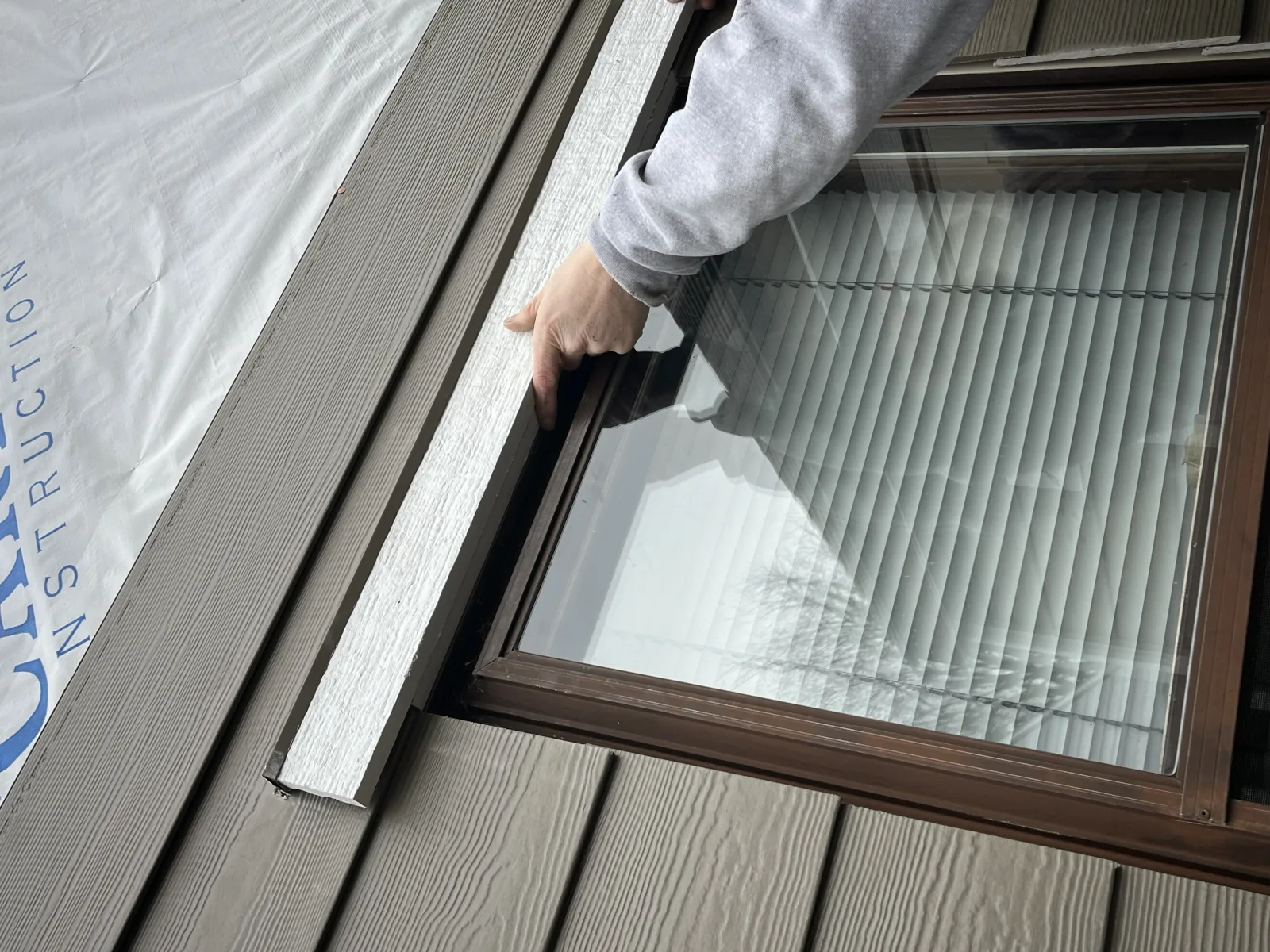
Trim boards as part of the drainage plan
Trim does more than frame a window. Head casing sheds water away from the top of the opening, and a properly set drip cap above it throws that water clear of the siding below. Side casings give the siding a clean edge to die into, with room for the panels to expand and contract.
With fiber cement or LP SmartSide, the trim and the siding belong to systems designed to work together, and the manufacturer spells out the gaps, the flashing and the fasteners. We are certified installers for both James Hardie and LP SmartSide, so the trim goes on to the maker’s spec instead of the fastest way. That matters at warranty time, because a manufacturer can decline a claim when the installation details are wrong.
Vinyl uses its own J-channel and window trim pieces. They work well when the channel is lapped correctly at the head so it drains, and badly when it collects water against the frame. That one detail separates a vinyl job that ages quietly from one that stains the sill inside.
Every layer around a window should overlap the one beneath it, the way shingles do on a roof.
Mixing lap and board and batten without creating new leaks
Many homeowners re-siding now want a mix: lap on most of the house, board and batten on a gable or a lower story, sometimes shakes up in a peak. On the right house it is a good look. Every place two styles meet, though, is a new transition that needs a plan.
Where vertical siding sits above horizontal, or the other way around, the joint needs a horizontal flashing with a proper lap behind it. A trim band can hide that joint and make the change look deliberate. Without flashing behind the band, water running down the upper wall finds the seam every storm.
We sketch those transitions with you before ordering material, because they decide where trim goes, how windows line up with the change, and how the corners finish. A combination that looks great in a magazine can fight the window layout on your house, and it is better to learn that on paper than halfway up the wall. Our siding replacement page for Holt goes deeper on material choices.
Closing the house up at the end of every day
A re-side opens your walls to the weather, and Michigan weather does not wait for anybody. Our rule is simple. At the end of each day, whatever we stripped is wrapped and taped, and any window we have opened up is flashed or covered. Nobody goes home leaving bare sheathing to face a forecast.
That rule shapes the schedule. We strip an elevation we can finish, or at least seal, the same day, and we leave the next wall alone until morning. It takes more planning than tearing the whole house down at once, and it turns a surprise overnight storm into a non-event.
Our own crew does the work start to finish. We never subcontract a wall to someone you have never met, so the people who talked through your windows with you at the start are the people who flash them. If a window turns out to be damaged beyond the trim, you hear it from them at the house, with the opening still exposed. For a smaller job, a panel or two near one window, see siding repair in Holt.
What homeowners ask about windows during a re-side
Do I need new windows when I re-side?
Not always. If the windows are sound and seal well, we flash and trim around them and they stay. If a window is failing anyway, replacing it during a re-side makes sense because the opening is already exposed. We will tell you which windows we think need attention and which ones are fine, and you decide.
Can you keep my existing trim style?
Usually. We can match the width and profile of what you have in a material that will not rot, or change it if you want a different look. On older houses with wide, deep casing, keeping that proportion matters a great deal to how the house reads from the street, and we pay close attention to it.
How long will my windows be exposed?
Only as long as the work on that wall takes. We open a section we can flash and close the same day, so no window sits unprotected overnight. If weather moves in midday, the opening gets covered before anything else happens. If you work from home, tell us which rooms matter and we plan around them.
Planning a re-side and wondering what is going on behind your window trim? Call (989) 900-0018 and we will come look, or tell us about the house. You get a free inspection and a fair price in writing, with every window detail spelled out.
Windows flashed in the right order, every one
Certified James Hardie and LP SmartSide installers, our own crew on every wall, and the house closed up before we leave each day.
(989) 900-0018 Or send us a note about your re-side →