
Panels that let the winter slide off and keep going.
Standing-seam and panel metal roofing for Haslett houses, installed by our own insured crew, with a straight read on whether metal is even the right call for yours.

What a metal roof does with Haslett snow.
Snow is the whole argument for metal around here. A shingle surface is rough enough to grab a pack and hold it all February, so the weight sits on your framing and the bottom layer slowly melts against warm decking, refreezes at the cold eave, and starts backing water up under the shingles. A smooth panel does not give the snow much to hang onto. It slides, usually in slabs, and the eave stays clearer of that melt-and-refreeze cycle. That changes the load your rafters carry and it changes how hard the bottom three feet of your roof has to fight all winter.
Shedding is only an advantage if you plan for where the slab lands. Before we set a single panel on a Haslett house we walk the ground under every eave and mark the spots that matter: the front steps, the path to the side door, where the cars actually park, the gas meter, and any shrubs somebody has been babying for years. Snow guards go above those, in a pattern sized to the pitch, so the roof releases in manageable amounts rather than dropping a month of winter on a walkway at once.
The other half is drainage. When a metal roof lets go, the runoff arrives fast and concentrated instead of soaking through a shingle mat, so the eave metal, the valley pans, and the gutter hangers all have to be set for a harder push than a shingle roof ever asks for. On a lakeside street where the air holds moisture longer into a thaw, that detail is the difference between a dry fascia and one that rots quietly for six years behind a gutter nobody ever looks behind.
The snow was always going to come off. The job is deciding where it lands before it does.
Profiles, gauges, and picking one honestly.
Metal is not one product. Standing-seam hides its fasteners under a raised, mechanically seamed or snap-locked rib, which is the version most people picture and the version we recommend on a house you intend to keep. Exposed-fastener panel is cheaper and faster and perfectly good on a pole barn or a detached shop, though every screw through the face is a gasket that ages, and there are a lot of them. Standing-seam has none of that on the flat of the panel.
Gauge is the next question, and thinner steel is where a low number usually comes from. Heavier gauge resists oil canning and hail dents better and feels different underfoot when a crew is walking it. Rib height and seam spacing matter too, because a wider panel on a long uninterrupted run shows waviness that a narrower one will not.
Then there is the honest part. If your house has a shallow pitch, a tangle of dormers, or a roof that is only nine years into a decent shingle, metal may be the wrong spend right now, and we will say so out loud during the free look. We are not going to talk a Haslett homeowner into a panel roof to make the day bigger. Andrew, Aaron, and Preston built this outfit around refusing that sale, and metal is the service where the temptation is strongest.
Metal roofing is one of the things we bring to this town and the rest of the county. Read more about metal roofing, see everything we do in Haslett, or book a free roof look.
Underneath the panels is where it is won.
Nobody buys a roof for the underlayment, and the underlayment is most of why one lasts. Steel gets hot under summer sun, so we run a high-temperature synthetic across the field rather than a standard felt that can soften and print through. At the eaves and up every valley we lay self-sealing ice-and-water membrane, wide enough to sit inside the warm wall line, because that is exactly where a Michigan ice dam parks and pushes water uphill.
Ventilation gets checked before we order anything. Plenty of the houses here were built when the ventilation was considered adequate and the standards have moved since, and a metal roof laid over a hot, damp attic will still grow frost on the sheathing every January. Intake at the soffit has to balance exhaust at the ridge or the whole assembly works against itself. We would rather correct that first than hand you a beautiful roof with the same old problem sealed underneath it.
Movement is the last one and the one that quietly ruins amateur metal work. Steel expands and shrinks meaningfully across a Michigan year, from a January morning to an August afternoon, and a panel screwed down tight has nowhere to go. Concealed clips let each panel float, which is why a properly seamed roof stays tight for decades while a pinned one starts weeping at fasteners within a few winters. Chimneys, sidewalls, and every roof-to-wall junction get flashed in matching metal, because sealant is a short-term answer and formed flashing is a long one.
Cottages, ranches, and newer builds.
Haslett’s housing does not come from one decade, and metal lands differently on each kind. On the older lake cottages, the ones that have been added onto more than once, the roofline is a collection of decisions nobody would make together on purpose, and the valleys and transitions are where trouble hides. Metal can be very good there because those valleys stop holding a wet mat of debris, but the flashing work is real and it has to be laid out carefully rather than improvised on the ladder.
The mid-century ranches are simpler on top and usually the easiest panel roofs we do. Long uninterrupted runs, few penetrations, and a pitch that sheds well. The catch on those is almost always underneath, in original soffits and an attic breathing the way it did decades ago, so the ventilation conversation comes before the panel conversation.
Newer builds tend to arrive at us right as the builder-grade shingles give out, which is the natural moment to decide whether to do this again in fifteen years or be finished with it. Those roofs often have steeper pitches and more articulation, so profile and color choice actually matter to how the house reads from the street. We will stand in the driveway with you and look at samples against your siding and trim rather than choosing off a chart at a desk.
Metal against another round of shingles.
The comparison worth making is over decades, not over one invoice. Here is how we lay it out at the kitchen table.
How long it stands
A properly installed standing-seam roof will normally see out two or three rounds of shingles, which is the reason people stop thinking about the roof entirely. Shingles are the lighter day one and the repeat customer over thirty years.
What winter costs you
Shingles hold the pack, so the eaves work harder and ice damage tends to be the thing that ends them early. A shedding panel roof takes that recurring winter fight off the table, which is worth more here than in a milder climate.
When shingles win
Complicated low-pitch rooflines, a short expected stay in the house, or a shingle roof with real life left in it. We say so plainly when that is the read, and we install shingle roofs too, so it costs us nothing to be straight with you.
Working around Haslett.
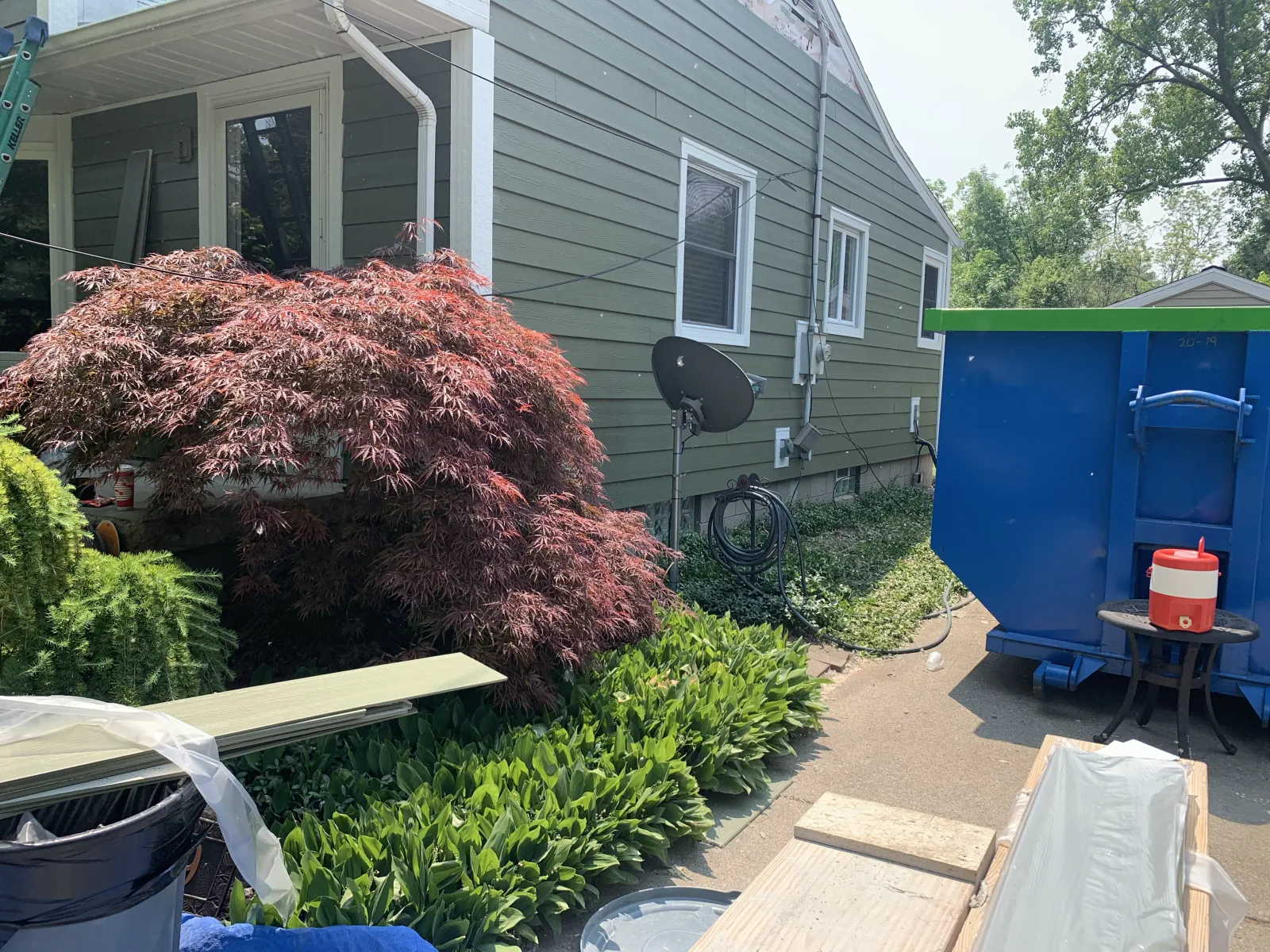
We work out of St. Johns and cover Haslett along with the rest of Ingham County. The five things homeowners here call us about most each have their own page, because a gutter run and a re-side are not the same conversation. The homes below are real Anchor jobs from around mid-Michigan.


More about metal roofing · every service in Haslett · call (989) 900-0018.
What people here ask before they commit.
Plain answers to the metal-roof questions that come up most, and finished jobs are in our gallery.
Will the snow really come off on its own?
On a decent pitch, yes, and that is the point of it. What we control is where it lands. We set snow guards above doors, walkways, and parking so the roof releases in smaller amounts instead of dumping a whole February on your steps at once.
Is a metal roof loud in rain or hail?
Far quieter than people expect. The noise everybody remembers comes from barns with bare panel over open framing. Over a solid deck with underlayment and an insulated attic beneath it, a panel roof sounds close to a shingle one from inside the house.
What does a metal roof do about ice dams?
It helps a great deal, because a smooth panel sheds the pack that feeds a dam in the first place. It is not a free pass, though. We still run ice-and-water membrane at the eaves and valleys, and we still fix attic ventilation, since a warm attic makes dams no matter what covers it.
Can you put metal over my existing shingles?
Sometimes it is allowed, but we rarely like it. Going over shingles hides whatever the decking is doing and makes the underlayment and ventilation work harder to get right. On most Haslett houses we tear off, look at the deck, and build up from a clean surface.
Will it dent from hail?
Heavier gauge steel handles our hail well, and the profile matters as much as the metal. We talk gauge honestly during the free look instead of quoting the thinnest panel to win on price. If a storm does hit, we handle the documentation and the claim.
How do I find out what mine would run?
We come out and look. The crew gets on the roof, checks the deck, the ventilation, and the flashing situation, then you get a written scope and a fair price in writing. We do not price a metal roof off a photo or a phone call.
Find out whether metal belongs on your house.
One visit, no obligation, and a straight answer either way. Call the crew and we’ll come look at Haslett.
(989) 900-0018